Realm: separating what to compute from when and where
Notes on Dr. Wei Wu's (NVIDIA) graduate-seminar talk on Realm, the explicit event-driven runtime under Legion and cuPyNumeric. The post follows one linear layer through tasks, events, the machine model, RegionInstance...
Notes on a graduate-seminar talk by Dr. Wei Wu (NVIDIA), given on . The ideas and results are the presenter's; the charts are my reconstructions from the slides.
On 22 September, Dr. Wei Wu, a Senior System Software Engineer at NVIDIA, gave our graduate seminar a tour of Realm. Realm is the task-based runtime that sits under Legion and cuPyNumeric. It started as a research project between Stanford and Los Alamos National Laboratory, where Wu worked on it as a research scientist. NVIDIA later decided to make a product on top of it, and Wu moved with it in 2022. It is still fully open source at github.com/StanfordLegion/realm.
What made the talk work was that it used a single example throughout. Every component of the runtime was introduced as the answer to one question about the same small computation. I’ll follow the same structure.
The running example
Take a linear layer followed by a ReLU:
To expose parallel work, split the shared dimension in two. becomes two column blocks and two matching row blocks:
That gives three tasks: GEMM 0, GEMM 1, and a final sum + bias + ReLU. The two GEMMs don’t depend on each other, so they can run concurrently. The final task needs both partial results. Everything else in the talk is about who says that, where each piece runs, and how gets to wherever the final task runs.
Who describes the dependencies?
There are two options:
- Implicit. In an OpenMP task program, each task declares what it reads and writes, and the runtime infers the edges by matching declarations on the same storage:
#pragma omp task depend(out: partial)for the producer,depend(in: partial)for the consumer. - Explicit. Realm makes the client supply the edges directly. Launching a task returns a completion event, and the consumer is launched with that event as its precondition.
Event ready = gpu0.spawn(GEMM, &args, sizeof(args));           // returns a completion event
Event done  = gpu0.spawn(CONSUME_PARTIAL, &b, sizeof(b), ready); // precondition = ready
The explicit model suits a low-level runtime, whose clients are compilers and higher-level runtimes that already know the ordering. Legion analyses data accesses and then hands Realm explicit events. Realm doesn’t second-guess them; it supplies the mechanism to execute them anywhere on the machine.
Five components, one question each
| Component | Question in the tensor example | Realm concept |
|---|---|---|
| Task | What computes each partial result? | a registered function, launched on a processor |
| Event | When can the output task run? | preconditions and completion events |
| Machine model | Where can work and data go? | processors, memories, affinities |
| Data | How is represented? | index spaces, fields, instances |
| DMA engine | How does reach its consumer? | copies and path planning |
Tasks. A task runs registered code on a chosen processor. It takes a precondition event and returns a completion event. The same task can have several implementations: the CPU version calls MKL and the CUDA version calls cuBLAS. The client picks a compatible processor and the matching implementation. Task granularity is up to the application. Two GEMMs suit two GPUs; four GPUs would suggest four.
Events. The final task needs ready and a local copy of . Realm expresses “both” by merging events:
Event ready = Event::merge_events(p0_ready, p1_local_ready);
Event done  = gpu0.spawn(FINALIZE, &args, sizeof(args), ready);
Nothing blocks here. The host builds the graph and keeps submitting work, and the runtime walks the graph as preconditions fire. There is no global barrier anywhere in the program, and Wu called that “the beauty of the Realm task programming model.”
CUDA interoperability. A host function returning and a GPU finishing the work it submitted are two different moments, and a correct integration has to carry the second one forward. Realm records a CUDA event after the kernel is enqueued and wraps it as a Realm event. Dependent work becomes eligible the moment the GPU finishes, not when the host task that launched it returns. Wu mentioned ongoing work to let the kernel itself signal a Realm event without returning to the host, which matters now that persistent “megakernels” are common.
Where does everything go? The machine model
Realm exposes a logical graph:
- Processors are execution resources.
- Memories are storage resources.
- Affinities describe access and transfer costs between them.
The client queries this graph to put GEMM 0 on GPU 0 next to and GEMM 1 on GPU 1 next to . On NVIDIA hardware, the edges might be PCIe, NVLink or an NVSwitch fabric. Because the model is logical rather than physical, the same program runs unchanged on a machine with a different interconnect.
How is a tensor represented?
This was the part of the talk I found most elegant. A Realm data object is built from three separate things:
- An index space: the set of valid coordinates, here all with and .
- A field: what lives at each coordinate, here 4 bytes interpreted as FP32.
- A layout: the map from coordinates and fields to addresses in a memory. One choice is row-major:
Bundle the three into a RegionInstance and you have a copyable handle, h_X, that names the data wherever it lives. Changing the layout changes nothing about the program. That separation is what lets the next trick work.
One virtual address range across GPUs. With a global-memory backend, an instance can represent the whole tensor even though physically sits in GPU 0’s memory and in GPU 1’s. Within a node, this uses CUDA virtual memory management; across nodes, it uses fabric memory over multi-node NVLink. The two physical pieces are mapped back-to-back into one contiguous virtual range. A kernel gets one base pointer and ordinary indexing, and the address translation picks the physical backing. One copy request moves the whole distributed tensor, and one completion event says it has arrived.
How does get to GPU 0? The DMA engine
copy() returns an event immediately. Returning doesn’t mean the transfer is done; the event fires later. Behind the call, Realm’s DMA engine plans the route. It searches over the channels the machine model exposes, scores them with a cost model, and can build multi-hop paths through intermediate buffers:
- Within a node: a direct peer transfer over NVLink when supported, or a staged path through host memory.
- Across nodes: multi-node NVLink inside an NVLink domain, or a NIC path with GPUDirect RDMA when the hardware and software allow it.
The program doesn’t change in either case. It is still one copy from a source instance to a destination instance.
The payoff is overlap. If GEMM 1 finishes first, the copy of can run while GPU 0 is still computing . The animation below compares the two scheduling models on our example. Assume GEMM durations , copy time and finalisation time , and ignore launch overhead. Then:
The explicit-event schedule saves whenever GEMM 0 is the longer one. That is exactly the communication that gets hidden.
Put together, the whole computation is five submissions and a graph:
flowchart LR
  G0["GEMM 0 on GPU 0<br/>P₀ = X₀W₀"] -->|p0_ready| M(("merge"))
  G1["GEMM 1 on GPU 1<br/>P₁ = X₁W₁"] -->|p1_ready| C["copy P₁ → GPU 0<br/>(DMA engine picks the path)"]
  C -->|copy_ready| M
  M -->|ready| F["FINALIZE on GPU 0<br/>Y = ReLU(P₀ + P₁ + b)"]
cuPyNumeric: the same machinery under NumPy
Nobody wants to write that graph by hand for a real application, and the higher layers exist so nobody has to. cuPyNumeric is a NumPy-compatible distributed array library.
- Application layer: expresses numerical work as array operations.
- cuPyNumeric: turns those into tasks and data requirements.
- Legion: derives the dependencies and maps the work.
- Realm: executes the tasks and copies with explicit preconditions.
This closes the loop on the implicit-versus-explicit question from the start. The user writes implicit-dependency code (plain array expressions), and the stack generates explicit events underneath.
Wu’s case study was a 10 TB microscopy reconstruction using iterative Richardson–Lucy deconvolution. The migration was changing import numpy as np to import cupynumeric as np.
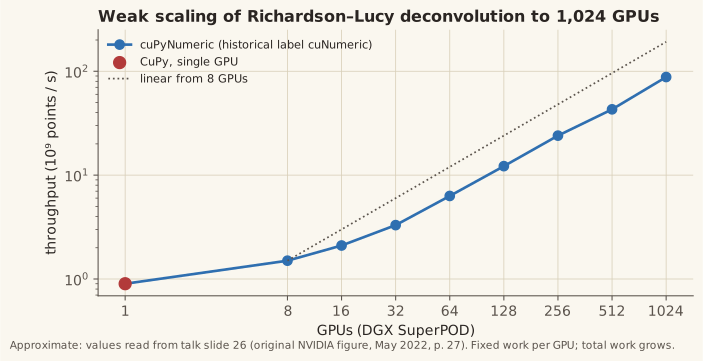
Weak scaling keeps the work per GPU fixed and grows the problem with the machine. Wu described the curve as scaling “almost linearly”. Reading values off the slide (approximately; the original is NVIDIA’s 2022 figure), the picture is more specific:
- Above 64 GPUs: throughput grows about 14× for a 16× increase in GPUs, which is nearly linear.
- 8 → 32 GPUs: the curve bends first, where cross-node communication starts to appear. Parallel efficiency, relative to linear extrapolation from 8 GPUs, settles around 45–55%.
The dotted line in my redraw makes that visible. That is still a very good result for unmodified NumPy code at 1,024 GPUs.
Career notes
The last part of the session was about working at NVIDIA, and it was refreshingly specific. Wu’s first NVIDIA interview asked him to write a producer–consumer queue, then a multi-threaded one, atomic or lock-free. He’d forgotten how. He only understood why they asked after joining the CUDA team: CUDA streams and events are a producer–consumer system. The other questions were about caches and cache lines, operating systems and architecture, not LeetCode puzzles.
On AI coding tools, his view was that they can implement a well-scoped piece but can’t yet decompose a system or reason about hardware. “You cannot just tell Codex, ‘write me a CUDA stream.’” Dr. Wang’s wrap-up added the systems view. On large machines, moving data between GPUs costs far more than the arithmetic, so hiding communication behind compute is where the performance comes from.
What I’m taking away
- Separate what from when and where. Realm’s whole design is three separations: task code from dependencies (events), dependencies from placement (machine model), and logical data from physical storage (RegionInstances). Each one lets a different layer of the stack make a decision without knowing about the others.
- Explicit events are a trace language. This is the connection to my own research. A Realm program is a partial order of operations joined by events. That is a Mazurkiewicz trace: every interleaving the runtime may choose is an equivalent execution. Checking an agent’s or a runtime’s behaviour then becomes checking that the observed trace belongs to the right language. Explicit dependencies make that language easy to write down; inferred ones don’t.
- No barrier is the feature. Most of the speed-up in the animation above comes from what the program doesn’t say. It never says “wait for everyone”; it says “start when your inputs exist.”
References
- Realm source and documentation: github.com/StanfordLegion/realm; Legion: legion.stanford.edu.
- cuPyNumeric: github.com/nv-legate/cupynumeric.
- Treichler et al., Realm: An Event-Based Low-Level Runtime for Distributed Memory Architectures, PACT 2014.
The weak-scaling values were read off a log-scale slide and are approximate. The schedule animation is a teaching model, not a measurement.