Future research: a USD-literate LLM and a knee-scene prediction challenge
A research plan for a fine-tuned LLM that reads, repairs and writes OpenUSD (.usda) scenes. It is anchored on my Archetypal Knee USD model and scored with a layered metric, usdfid. The page covers the datasources and their licences, a review of existing 3-D and scene LLMs, Autodesk's OpenUSD work, a Colab-to-Megatron-Bridge training path, and a challenge design. Working prototypes are included.
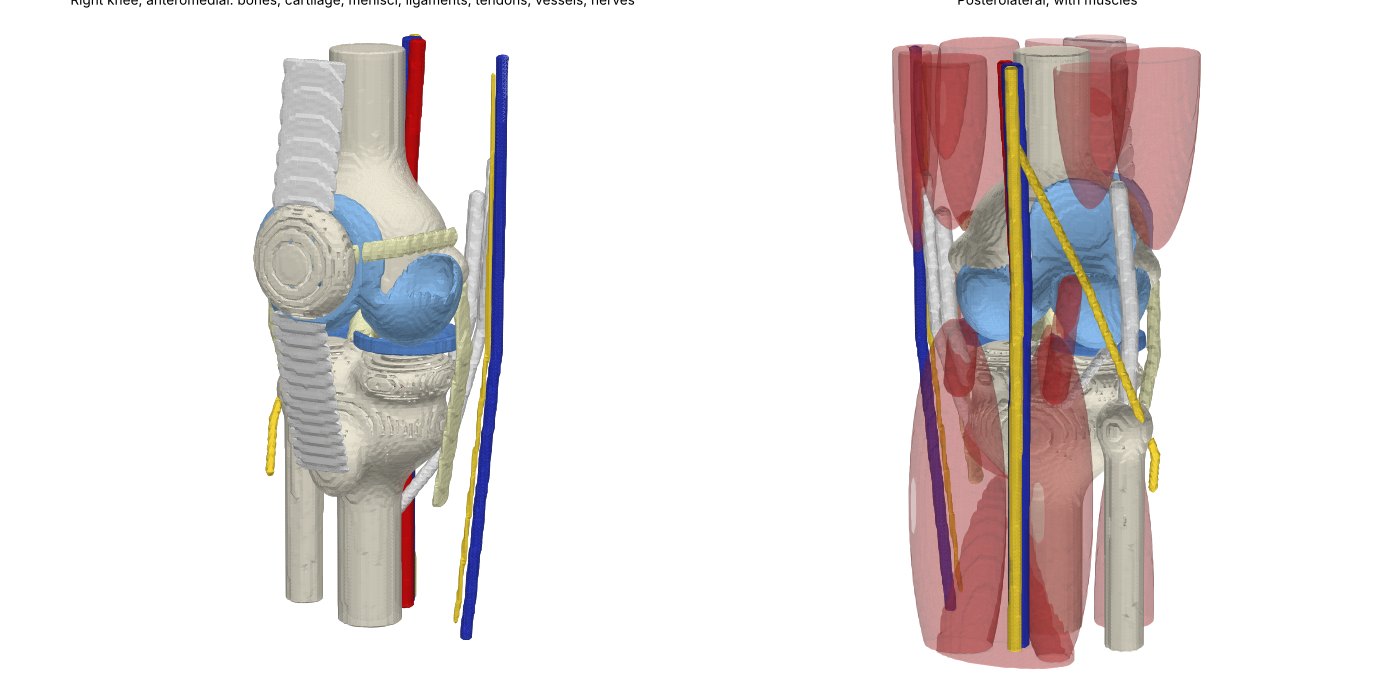
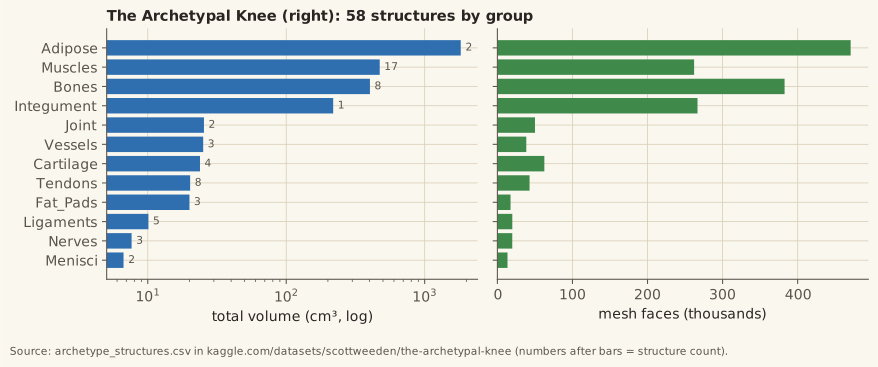
Where this starts. In October I published The Archetypal Knee. It is a healthy right and left knee written entirely in OpenUSD: 58 labelled anatomical structures per knee, each mesh carrying knee:volumeMm3, knee:surfaceAreaMm2 and 1.5 T MRI tissue properties. Six MRI acquisitions are stored as prims, and 224 synthetic DICOM images were rendered from the USD alone. A companion notebook, Knee USD Fidelity Arena, has Gemma 4 agents built with Google ADK write the pieces of a challenge:
- O1: a fidelity metric with controlled corruptions.
- O2: source scenes from natural-language descriptions.
- O3: labelled pairs for a verification track.
This page turns that into a research plan. Every external claim links to its source. Where I couldn’t verify something, I say so.
Clinical framing. The archetype and any anomaly maps built from it are research artefacts, not diagnostic tools. The archetype is a plausible healthy knee built from procedural shapes, not population-average anatomy. For example, its femoral cartilage comes out at about 20 cm³, roughly double typical values.
1 · Why this is a real gap
The production USD language model today is NVIDIA’s USD Code NIM. It is Llama-3.1-70B-Instruct plus retrieval, it writes OpenUSD Python rather than .usda, and it has no downloadable fine-tuned weights (model card). The closest open research is IL3D (Oct 2025), which stores 27,816 room layouts as USDA and fine-tunes Qwen3 1.7B–14B to generate them (arXiv 2510.12095). No one has yet built a model that reads and writes .usda, judged by a USD-native fidelity metric, on an anatomical scene. That is a defensible gap.
2 · Review of the existing 3-D model (my archetype)
| Stage layout | knee_archetype.usda (master) → anatomy layer → one .usda per acquisition (Sagittal/Coronal/Axial × FS/non-FS) → binary .usdc mesh layers |
| Units and frame | millimetres, DICOM patient LPS (+X left, +Y posterior, +Z superior); right knee at x = −90 mm, left at +90 mm (exact mirror) |
| Per-mesh schema | knee:label, knee:tissue, knee:volumeMm3, knee:surfaceAreaMm2, mri:t1Ms, mri:t2Ms, mri:protonDensity, mri:fatFraction, mri:flowVoidFraction |
| Geometry | procedural signed-distance shapes voxelised at 0.5 mm; marching cubes on the label volume; ≈1.65 M mesh faces per knee |
| Round trip | the synthetic DICOM were re-read by the included cataloguer, and all 12 series came back with the expected plane, fat suppression, sequence class, spacing and laterality |
| Licence | CC BY-NC 4.0 |
What the review means for an LLM.
- Good: the stage is already layered the right way. Structure, transforms and attributes live in small text layers, and geometry lives in
.usdc. That is exactly the split a language model needs, as Section 6 shows. - Weak: the anatomy is not population-average, there is one archetype rather than a distribution, and nothing yet varies the anatomy within healthy ranges. The plan therefore adds anatomical variants before training and holds them out at test time.
3 · Datasources
Converting any USD flavour to text is one command: usdcat -o out.usda in.usdc, with --flatten to bake in references and variants (OpenUSD tutorial). pip install usd-core gives the core libraries (PyPI, 26.11). For non-USD formats, use guc for glTF/GLB→USD and Adobe’s USD file-format plugins for FBX, OBJ, PLY and STL. Licences are the binding constraint.
| Source | Licence | Size | Use in this plan |
|---|---|---|---|
| My archetype + generated corruptions/variants | mine (CC BY-NC for the published data) | unbounded | core training and test data |
| NVIDIA PhysicalAI-SimReady-Warehouse-01 | CC-BY-4.0 | 753 USD assets | general USD fluency |
| usd-wg/assets | Apache-2.0 repo, assets typically CC0 | small, incl. deliberately malformed files | externally authored repair cases |
| Infinigen Indoors | BSD-3 (output is yours) | procedural, exports whole scenes to USD | unlimited licence-clean scene/text pairs |
| IL3D | unverified | 27,816 USDA layouts | baseline and comparison |
| ALab (Animal Logic) | ASWF Digital Assets Licence (ML training not mentioned) | 300+ assets, mostly .usda |
evaluation only until the licence is clarified |
| Objaverse / -XL | ODC-By overall, per-object licences | 800 K / 10.8 M objects | geometry pretraining, filtered to CC-BY/CC0 |
| OAIZIB-CM (knee MRI + 5-label masks) | CC BY-NC 4.0 | 507 MRIs | anatomical realism track: marching cubes → UsdGeom.Mesh |
| TotalSegmentator v2 | CC BY 4.0 (the appendicular-bones model’s licence forbids training similar algorithms) | 1,228 CTs | femur only; avoid the restricted bones |
| Pixar Kitchen Set | personal testing only, no redistribution | — | private sanity check, never in a dataset |
| SKI10 | closed | — | not usable |
4 · Review of existing 3-D and scene LLMs
| Model | Predicts | Representation | Weights |
|---|---|---|---|
| NVIDIA USD Code | OpenUSD Python, Q&A | Python + RAG; Llama-3.1-70B | hosted NIM only |
| IL3D-SFT | text → room layout | USDA; Qwen3 1.7B/4B/14B | unverified |
| LLaMA-Mesh | text ↔ mesh in chat | OBJ as plain text, quantised coordinates, no new tokens; Llama-3.1-8B | yes (non-commercial) |
| SpatialLM | point cloud → walls, doors, boxes | structured text layout; 0.5–1 B | yes (CC-BY-NC) |
| SceneScript (Meta) | point cloud → layout + boxes | structured-language tokens | via project (CC BY-NC) |
| CAD-Recode | point cloud → CadQuery Python | code, execution-scored; Qwen2-1.5B | yes |
| Roblox Cube | text → shape, LLM scene graph | discrete shape tokens | yes |
| LayoutGPT, Holodeck | text → 3-D layout | prompted JSON/text | prompting only |
Three takeaways:
- Serialise as text, without new tokens (LLaMA-Mesh).
- Execute, then score (CAD-Recode). The USD equivalent is to open the generated stage and measure it.
- Compare against IL3D, with USD Code as a zero-shot baseline.
5 · Autodesk
- Standards. Autodesk is a founding member of the Alliance for OpenUSD. AOUSD released Core Specification 1.0 in January 2026. It defines the USDA grammar, composition and value resolution, which is exactly what the L0/L1 layers of the metric should be anchored to.
- Open-source tooling. maya-usd, 3dsmax-usd, arnold-usd and the Aurora Hydra path tracer. These are mainly data-generation tools: DCC exporters turn existing scenes into
.usdatraining pairs. - Generative 3-D.
- Project Bernini trained on about 10 M shapes and is not public.
- Its open, non-commercial descendants WaLa-SK-1B and Make-A-Shape generate wavelet-encoded TSDFs.
- Use in this plan: a geometry baseline. Generate a mesh, wrap it in USD, and score it with the same
usdfid.
- No Autodesk USD dataset or benchmark was found.
6 · The tokenizer problem, measured
Before choosing a model, I counted tokens for the same eight-mesh toy knee (720 vertices) in five text forms, using each model’s own tokenizer:
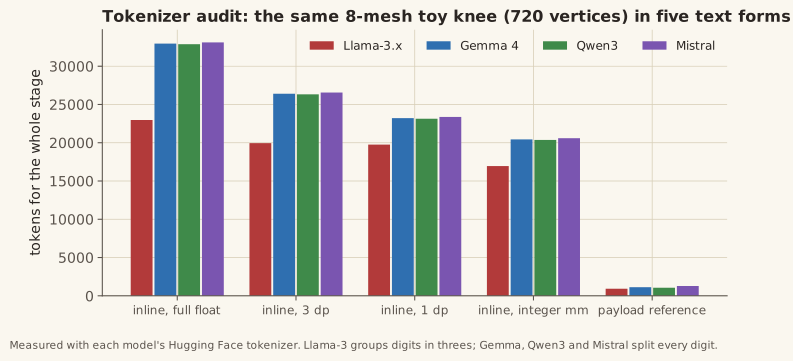
- The tokenizer matters. Llama-3 groups digits in threes; Gemma 4, Qwen3 and Mistral split every digit. Inline point arrays therefore cost 31–44 tokens per vertex (including the face indices).
- Scaled up. At 44 tokens per vertex, the real archetype (≈1.65 M faces per knee) would need on the order of tens of millions of tokens per knee inline. That is impossible.
- The fix. Moving geometry into a payload reference cuts the stage to about 1,000 tokens. The model writes structure, transforms and attributes, and references geometry. Quantising coordinates (as LLaMA-Mesh does) helps only within a factor of two.
7 · usdfid: a layered score
A single number lets a model trade validity for geometry without anyone noticing. So every layer is reported separately, and a parse failure scores zero:
| Layer | Check | Tool |
|---|---|---|
| L0 parse/compose | opens, composes, no unresolved references | Sdf.Layer.ImportFromString, Usd.Stage.Open |
| L1 validity | new validation errors vs the reference | UsdValidation (usdchecker’s successor) |
| L2 structure | prim-path Jaccard × type match × stage metadata (upAxis, metersPerUnit, defaultPrim) |
custom |
| L3 attributes | world-transform error, knee:* values with tolerances |
custom (usddiff has no numeric tolerance) |
| L4 geometry | Chamfer + F-score@τ, τ = 1% of the bounding-box diagonal (Tatarchenko et al.) | numpy |
A working prototype is in notebooks/usd-llm/usdlab.py. On eight corruption families × 20 seeds, each family moves a different layer:
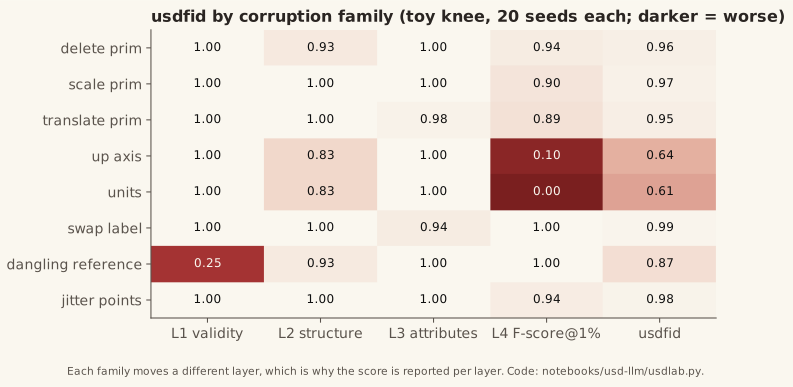
- Swapping two structures’ labels costs only 0.015 overall but shows clearly in L3. For anatomy, a mislabelled cartilage is a serious error, which is why the challenge needs per-layer leaderboards.
- A wrong
upAxisormetersPerUnitleaves structure intact but destroys geometry, because the stage is read the way it declares itself. - A dangling reference shows only in L0/L1.
8 · Training plan: Colab prototype → Megatron at scale
flowchart LR
  A["Phase 0 · Colab CPU<br/>corpus, corruptions,<br/>token audit, usdfid"] --> B["Phase 1 · Colab GPU<br/>Unsloth QLoRA<br/>Gemma 4 E4B / 31B"]
  B -->|"beats zero-shot<br/>on held-out families"| C["Phase 2 · 8×A100/H100<br/>Megatron-Bridge LoRA / SFT<br/>Qwen3-8B → 32B"]
  C --> D["Phase 3 · multi-node<br/>continued pretraining on .usda<br/>(Megatron-LM preprocess_data)"]
  C --> E["Export HF adapter →<br/>vLLM + ADK arena"]
  B --> E
Why Megatron-Bridge. Megatron-LM’s own HF-conversion doc now points to Megatron-Bridge (doc). Bridge (Apache-2.0, PyPI 0.6.x, Python 3.12) does HF↔Megatron conversion, SFT and LoRA, and pins Megatron-Core as a submodule. My Megatron-LM fork replaces that submodule only if I carry core patches.
Why Qwen3 for the cluster phase. It has the most complete set of published Bridge recipes, and it matches IL3D. The recipes:
| Recipe | TP/PP | Nodes |
|---|---|---|
qwen3_8b_peft_config |
1/1 | 1 |
qwen3_32b_peft_config |
1/1 + recompute | 1 |
qwen3_8b_sft_config |
4/1 | 1 |
qwen3_32b_sft_config |
8/2 | 2 |
Source: Qwen3 recipes.
Gemma 4 stays on the HF/Unsloth/vLLM side for now. A 31B text SFT recipe for it was not confirmed in Bridge.
Compute. These are upper bounds, using (Kaplan et al.), 312 TFLOPS BF16 per A100, and an assumed 40% MFU:
| Run | FLOPs | A100-hours |
|---|---|---|
| E4B × 20 M tokens | 4.8 × 10¹⁷ | ≈ 1 (Colab) |
| Qwen3-8B × 1 B tokens | 4.8 × 10¹⁹ | ≈ 110 (≈ 14 h on 8×A100) |
| 32B × 1 B tokens | 1.9 × 10²⁰ | ≈ 420 (≈ 2.2 days on 8×A100) |
A realistic first corpus is 50 k stages × 5–20 k tokens, or 0.25–1 B tokens.
The notebooks
| Notebook | Runtime | Status |
|---|---|---|
| 01 · corpus, corruptions, usdfid, token audit | CPU | runs end-to-end (checked with usd-core 26.11) |
| 02 · QLoRA prototype with Unsloth | L4/A100 | scaffold; not yet run |
| 03 · Megatron-Bridge runbook | Colab → cluster | data prep runs; training is on the cluster |
9 · Challenge design
- Repair (O1). A corrupted knee stage in, the fixed
.usda(or a minimal override sublayer) out. Whole corruption families are held out between train and test (the notebooks hold outunitsandswap_label), along with anatomical variants. The usd-wg malformed assets add externally authored cases. - Text → stage (O2). A healthy-baseline description in, a stage out, scored against the archetype.
- Anomaly localisation (O3 + imaging). A patient-derived stage, or OAIZIB-CM meshes, in. Out: a ranked list of prim paths that deviate from the archetype (scored by mAP / top-k), and a voxel divergence map scored by Dice and AUROC against synthetic ground-truth deformations.
- Verification. Classify a stage pair as faithful or corrupted, scored by AUROC / F1.
The format is a code competition with a hidden test set, and the scorer runs deterministically on CPU with usd-core.
10 · Risks and open questions
- Licences. Build the public challenge only from self-generated archetype data and CC-BY/CC0/BSD-generated content.
- Leakage. Corruptions of a single archetype are easy to memorise, so hold out families and anatomy.
- Metric validity. CLIP-style semantic scores agree only weakly with human judgement (3DGen-Bench), so validate
usdfidagainst a small expert-rated set before trusting it. - Tooling. It is unverified whether the
usd-corewheel ships theusdcat/usdcheckerCLIs; the Python APIs above do the same jobs. Megatron-Bridge needs Python 3.12. Gemma 4 support in Bridge is partial. - Model naming. My arena notebook lists a “Gemma 4 12B”. That size is real: the Gemma 4 Developer Agent competition allows
gemma-4-12b-it-qat-w4a16-ctalongside the 31B, E4B and E2B checkpoints. Pin the exact checkpoint name in every config so results stay comparable.
Research for this page was compiled on 26 October 2026. The full annotated source list (≈70 links) is in the plan’s research notes.